History of (tagg)Art...
HomeNatureIdentityRenaissanceBaroque

Nature

  • All Nature artworks
  • Landscape or Seascape in 2D
  • Animals in 2D or 3D
  • The Elements (Fire, Water, Wind or Earth) in 2D or 3D
  • +3 more topics

Identity

  • All Identity artworks
  • The Divine in 2D or 3D Works
  • Portraits in 2D Works
  • Portraits in 3D Works
  • +3 more topics

Renaissance

  • All Renaissance artworks
  • Religious Painting
  • Religious Sculpture
  • Mythological in 2D or 3D
  • +3 more topics

Baroque

  • All Baroque artworks
  • Religious Painting
  • Religious Sculpture
  • Mythological Painting
  • +6 more topics

About

A comprehensive study resource for Pearson Edexcel History of Art A-Level.

NatureIdentityRenaissanceBaroque

History of (tagg)Art... - A-Level Study Resource

Pearson Edexcel Specification

Admin
  1. Home
  2. Renaissance
  3. Sleeping Venus

Sleeping Venus

Giorgione, c.1510
RenaissanceMythological in 2D or 3DVenice
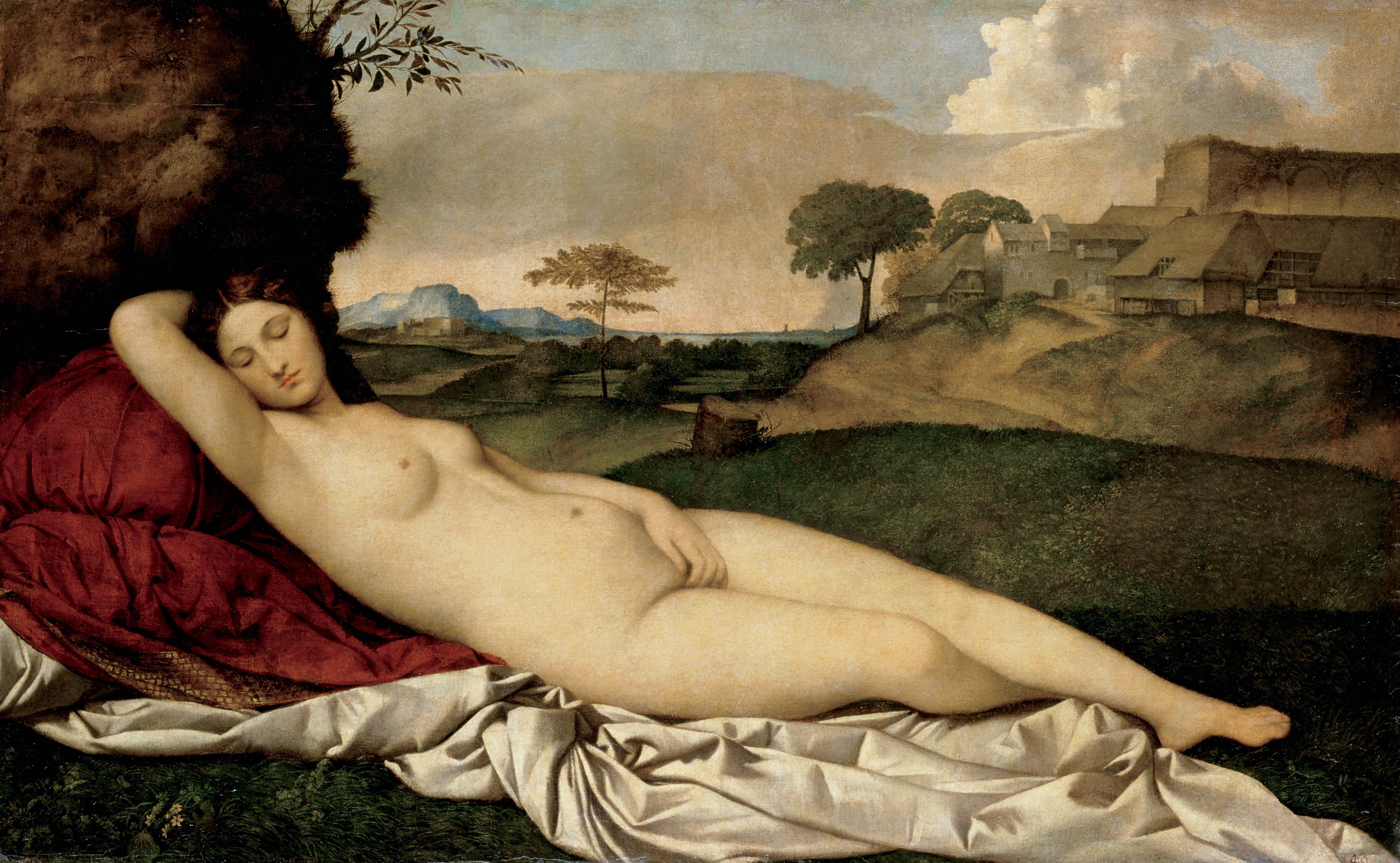
Sleeping Venus by Giorgione
Giorgione (completed by Titian), Sleeping Venus (Dresden Venus), c. 1508-1510, oil on canvas, 108.5 × 175 cm, Gemäldegalerie Alte Meister, Dresden

Overview

About This Work

Sleeping Venus (Italian: Venere dormente; also known as the Dresden Venus) is a monumental oil painting by the Venetian master Giorgione (Giorgio da Castelfranco, c. 1477–1510), begun around 1508 and left unfinished at his death in 1510. The work was subsequently completed by Titian, who added the background landscape and possibly portions of the drapery. Now housed in the Gemäldegalerie Alte Meister (Old Masters Gallery) in Dresden, it measures 108.5 × 175 centimetres—a wide horizontal format suggesting placement as a decorative panel in a noble household. The painting depicts a fully reclining nude female figure—identified as Venus, goddess of love and beauty—sleeping peacefully in a pastoral landscape. She occupies the entire width of the composition, her body's soft curves echoing the rolling hills of the background in a visual harmony of human and natural form. The work is historically significant as the first known reclining female nude in Western painting since classical antiquity, establishing a genre that would dominate European art for centuries. Yet it transcends mere eroticism through its poetic sensibility, serene melancholy, and profound integration of the human figure with the natural world. The painting was likely commissioned to celebrate a marriage, and through its symbols of fertility, Venus represents not merely the object of desire but the cosmic principle of life itself—the great mother figure generating all life and abundance.

Visual Analysis

Composition

The composition is dominated by a single figure: Venus, rendered as a full-life-size female nude reclining across the entire width of the canvas. Her body displays soft, luminous flesh rendered with Giorgione's masterful oil technique—warm tones creating the impression of living, glowing skin. The figure is idealized yet naturalistic: not the harsh muscularity of male nudes or the androgynous forms of some Renaissance depictions, but fully feminine, with voluptuous curves emphasizing breasts, waist, hips, and thighs. Her pose is luxurious and languid. Her right arm is stretched behind her head, creating an elongated line that extends the length of her body. Her left hand rests gently on her lower abdomen. This pose simultaneously conveys sensuality and vulnerability: the figure is exposed and defenseless in sleep, yet appears utterly at ease and serene. The pose derives ultimately from classical Venus Pudica (Venus of Modesty) sculptures, where the hand placement ironically emphasizes rather than conceals sexuality. What makes the Sleeping Venus so revolutionary is not merely the depiction of the nude female figure, but the way her body's contours echo and harmonize with the landscape behind her. Her reclining profile—the curve of her breast, the line of her hip and thigh—mirrors the gentle roll of the green hills in the background. This visual correspondence suggests that human beauty and natural beauty are expressions of the same divine principle. The female form is not alien to nature; it is nature's most perfect expression.

Colour & Light

The painting is suffused with a warm, golden-green light characteristic of Venetian painting. The sky is softly rendered without harsh contrasts; there is no dramatic chiaroscuro, no pointed shadows. Instead, light transitions smoothly throughout, creating a timeless, dreamlike atmosphere. The warmth suggests either early morning or an eternal moment outside of historical time. The color palette is harmonious and warm throughout—except for the silver-white drapery upon which Venus reclines. This drapery, which art historians generally attribute to Titian's later completion, creates a note of cold, bright color that disrupts the warm harmony of the composition. Many scholars note that the silver cloth sits "uncomfortably" with Giorgione's serene, pantheist vision, suggesting a dissonance between Giorgione's original intention and Titian's later completion. The rolling green hills are rendered in soft, warm greens with subtle atmospheric perspective. The contours flow as gently as the contours of the goddess's body. The vegetation is extraordinarily lush—references to fertility appear throughout: bay trees (symbol of victory) frame the composition; small yellow anemone flowers (symbols of fleeting beauty and mortality) bloom in the foreground.

Materials & Technique

Giorgione's mastery of oil painting on canvas was unprecedented. His use of subtle gradations of warm color to create luminosity and softness influenced the entire Venetian tradition. Rather than using line to define form, he used color and light. Flesh appears warm and glowing; landscape appears soft and atmospheric. The entire painting is unified through warm tonality. The brushwork is fluid and painterly. Rather than using hard outlines or linear definition, Giorgione defines form through color transitions and soft modeling. Flesh blends seamlessly into drapery, which blends into landscape. This soft, almost liquid quality creates the impression of a world without harsh divisions—a unified natural and human realm. Giorgione was among the first to abandon preparatory drawing entirely, painting directly onto the canvas without preliminary sketches. This freed him from the linear tradition and allowed him to work spontaneously with color and light—essentially inventing the painted sketch, the modello or preliminary study done in oil directly on canvas.

Historical Context

Context

Giorgione was a meteoric figure in Venetian Renaissance art. Born around 1477, he died in October 1510 at the mere age of 33. Yet in his short career, he fundamentally transformed Venetian painting. A student of Giovanni Bellini, Giorgione learned the traditions of Venetian tempera and oil painting, but he revolutionized them. The Sleeping Venus was left incomplete when Giorgione died in 1510. According to a contemporary document from 1525, the painting was in the collection of Girolamo Marcello, a wealthy Venetian patrician, and the notation explicitly states that while Giorgione painted the figure, the landscape "was finished by Titian." Titian, already a rising star in Venetian art, completed the work, likely following sketches or indications left by Giorgione. The painting was almost certainly commissioned to celebrate a marriage. The custom of commissioning paintings as marriage gifts (epithalamia) was well established in Renaissance Italy. The choice of Venus as subject is significant: as the goddess of love and fertility, Venus served as the patroness of marriage. Humanist scholars of Giorgione's circle drew on ancient Roman and Greek poetry—Lucretius and Ovid—which described Venus not merely as the goddess of love, but as Venus Genetrix, the mother of all living things, the cosmic principle from which all life springs.

Key Themes

First Reclining Nude and Venetian Innovation

This painting is historically significant as the first known reclining female nude in Western painting since the classical world. During the medieval period and the Early Renaissance, monumental female nudes were virtually unknown. Male nudes could be justified as classical and athletic; female nudes were more suspect, associated with lust and corruption. Giorgione's solution was brilliant: by depicting the figure as sleeping, he idealized and spiritualized the nude. Sleep removed any suggestion of waking seduction or active desire. The figure becomes an object of contemplation rather than active provocation. The sleeping state allowed Giorgione to depict sensuous beauty without explicit eroticism—a distinction that proved crucial for the work's acceptance. As one scholar writes: "Venus denotes not the act of love but the recollection of it." The painting established a genre that would dominate European art for centuries. Titian directly based his celebrated Venus of Urbino (1538) on this composition, transforming the sleeping figure into an awake, seductive woman gazing directly at the viewer—a shift toward more explicit eroticism. Yet the debt to Giorgione's original remains unmistakable. The "reclining female nude became a distinctive feature of Venetian painting" and influenced artists throughout Europe for centuries.

Exam Focus Points

Critical Perspectives

Key examination themes include: (1) First Reclining Female Nude Since Classical Antiquity—why this subject matter was revolutionary in early 16th-century art, how sleep functioned as justification for depicting a sensuous nude, and the painting's influence on later artists, especially Titian; (2) Body and Landscape Harmony—how Venus's body curves echo the rolling hills, what philosophical meaning this correspondence suggests, and how it expresses pantheist or nature-based spirituality; (3) Sleep as Idealization—the distinction between depicting Venus awake vs. asleep, how sleep elevates the work from explicit eroticism to poetic contemplation; (4) Giorgione's Artistic Innovations—his revolutionary approach to oil painting (direct painting without preliminary sketching), how he essentially invented landscape painting as independent artistic concern; (5) Symbolic Elements—agricultural symbols (mills) suggesting fertility, bay tree as symbol of triumph, anemones as symbol of fleeting beauty and mortality, two trees as possible representation of bride and groom; (6) Epithalamic Function—why this painting was likely commissioned to celebrate a marriage, how Venus as patroness of fertility relates to marital blessing; (7) Venus Genetrix—the humanist conception of Venus as ultimate feminine principle, source of all life; (8) Titian's Completion—what Titian added to the painting, why the silver drapery disrupts Giorgione's warm harmony; (9) Comparison with Later Works—how Titian's Venus of Urbino transforms Giorgione's sleeping figure, the shift from contemplative sleep to seductive wakefulness.

On this page

OverviewVisual AnalysisHistorical ContextKey ThemesExam Focus Points