History o' Phoeart
  • Home

Nature

  • Overview
  • Landscape or Seascape in 2D
  • Animals in 2D or 3D
  • The Elements (Fire, Water, Wind or Earth) in 2D or 3D
  • The Relationship between Man/Woman and Nature in 2D or 3D

Identity

  • Overview
  • The Divine in 2D or 3D Works
  • Portraits in 2D Works
  • Portraits in 3D Works
  • Gender Identity in 2D or 3D Works

Renaissance

  • Overview
  • Religious Painting
  • Religious Sculpture
  • Mythological in 2D or 3D
  • Portraits in 2D or 3D

Baroque

  • Overview
  • Religious Painting
  • Religious Sculpture
  • Mythological Painting
  • Mythological Sculpture

About

A comprehensive study resource for Pearson Edexcel History of Art A-Level.

NatureIdentityRenaissanceBaroque

History o' Phoeart - A-Level Study Resource

Pearson Edexcel Specification • Use ⌘K to search

  1. Home
  2. Paper 1
  3. Identity
  4. The Divine in 2D or 3D Works
  5. The Ascoli Annunciation
Paper 1Identity
Identity
The Divine in 2D or 3D Works
Pre-1850
Tara

Tara

Unknown

Christ with the Woman Taken in Adultery

Christ with the Woman Taken in Adultery

Rembrandt

The Ascoli Annunciation

The Ascoli Annunciation

Carlo Crivelli

Post-1850
Portraits in 2D Works
Portraits in 3D Works
Gender Identity in 2D or 3D Works
Ethnic Identity in 2D or 3D Works
Identity in Architectural Works

6 scopes • 24 artworks

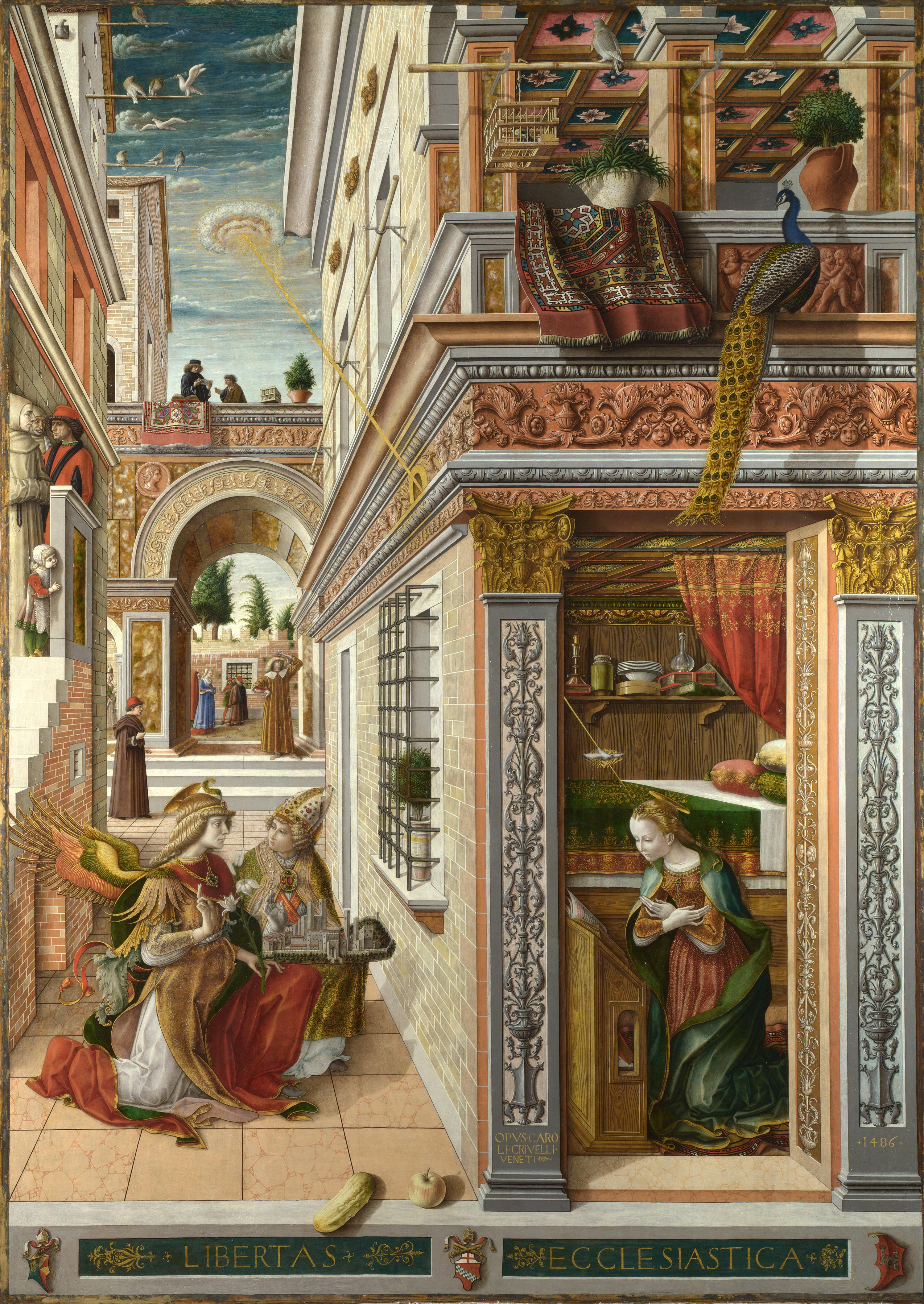
The Ascoli Annunciation

Carlo Crivelli, 1486
IdentityPre-1850
The Ascoli Annunciation by Carlo Crivelli
Carlo Crivelli, The Annunciation, with Saint Emidius, 1486, egg tempera and oil on canvas (transferred from wood), 207 x 146.7 cm, National Gallery, London

Overview

About This Work

The Annunciation, with Saint Emidius (1486) is the most celebrated masterpiece by the Venetian painter Carlo Crivelli, housed in the National Gallery, London. Measuring a monumental 207 x 146.7 cm (egg tempera and oil on canvas, transferred from wood), it was commissioned as an altarpiece for the church of the Santissima Annunziata in Ascoli Piceno (in the Italian Marches). The painting commemorates a specific historical event: the granting of partial self-government (Libertas Ecclesiastica) to the city of Ascoli by Pope Sixtus IV in 1482. The news reached the city on March 25th—the Feast of the Annunciation—linking the civic triumph with the biblical event. Consequently, the painting is a unique hybrid of religious narrative and civic propaganda. It depicts the moment the Archangel Gabriel announces Christ's conception to Mary, but Gabriel is notably interrupted by Saint Emidius (Ascoli's patron saint), who proudly displays a model of the city. The work is famous for its extreme perspectival distortion, lavish decorative detail, trompe-l'œil effects, and bizarre inclusion of symbolic objects like a giant cucumber. It exemplifies Crivelli's idiosyncratic, highly ornamental style that blends International Gothic richness with Renaissance spatial science.

Visual Analysis

Composition

Deep Linear Perspective: The composition is dominated by an exaggerated application of one-point linear perspective. A paved street recedes dramatically from the foreground to a distant city gate and landscape. The orthogonal lines of the architecture converge sharply, creating a tunnel-like depth. However, this mathematical space is packed with so much ornamental detail that it feels claustrophobic rather than spacious. The Division of Space: The painting is divided vertically by the wall of Mary's house. • The Street (Left): The public, male-dominated space where Gabriel and St. Emidius converse. • The Room (Right): The private, female domestic space where Mary kneels in prayer. The Penetrating Light: The two spaces are connected by a divine golden ray originating from a vortex of angels in the sky. This ray passes through a specifically designed hole in the frieze of the building to strike Mary's head, symbolizing the Immaculate Conception. The Figures: Gabriel kneels in the street, gesturing towards Mary, but turns his head to listen to St. Emidius. Emidius, dressed in bishop's robes, holds a detailed model of Ascoli Piceno, pointing out its features to the angel. This conversational interaction between a celestial being and a local saint is highly unusual and charmingly provincial. Trompe-l'œil and Theatricality: Crivelli loves illusion. The cucumber and apple in the foreground appear to project out of the picture plane and into the viewer's space (foreshortening). They cast shadows over the inscription, suggesting they are sitting on the frame itself. This breaks the "fourth wall" and asserts the artist's virtuosity.

Colour & Light

Opulent Materiality: The painting simulates precious materials with obsessive detail. We see oriental carpets draped over balconies (signs of wealth and trade), gold-embroidered fabrics, veined marble, carved stone, and metallic golds. Crivelli uses pastiglia (raised gesso work) to make the keys of St. Peter, the saint's crozier, and the jewels on Gabriel's clothes physically three-dimensional, standing out from the canvas. Saturated Palette: The colours are intense and jewel-like—rich reds, golds, emerald greens, and lapis blues—painted in egg tempera, which allows for sharp, precise lines and permanence of colour. Unlike the soft blending (sfumato) of his contemporary Leonardo da Vinci, Crivelli's lines are hard, crisp, and metallic. The Golden Light: The divine ray is rendered in actual gold leaf, as is the halo of the dove (Holy Spirit). This medieval use of gold contrasts with the Renaissance perspectival setting, creating a tension between the spiritual and the material.

Materials & Technique

Egg Tempera and Oil: Crivelli worked primarily in egg tempera, a medium that dries quickly and allows for fine, hatched details but not easy blending. This contributes to the sharp, linear quality of his work. He may have used oil glazes for some richer colours, but his technique remains rooted in the meticulous craftsmanship of the Venetian and Paduan schools (influenced by Mantegna). Multimedia Surface: The inclusion of raised relief (pastiglia) and extensive gilding makes the painting fundamentally an object rather than just a window. It glitters and reflects light, functioning like a piece of jewellery or goldsmith's work.

Historical Context

Context

Libertas Ecclesiastica (1482): The painting's primary function was political. Ascoli had long suffered under strict papal rule. In 1482, Pope Sixtus IV granted the city "ecclesiastical liberty" (limited self-rule). The news arrived on the Feast of the Annunciation. The inscription at the bottom—LIBERTAS ECCLESIASTICA—along with the papal, civic, and bishop's coats of arms, explicitly celebrates this political victory. The painting asserts: "Our freedom is a gift from God, delivered by the same angel who brought Christ." Civic Pride: Saint Emidius is shown protecting the city model. The model is so detailed that specific towers and walls of 15th-century Ascoli can be identified. This is an assertion of civic identity and local patriotism. Crivelli's Career: Crivelli was a Venetian who was exiled (for adultery) and spent his career in the provincial Marches region. Because he worked away from the major artistic centres (Florence, Rome, Venice), he developed a highly personal, slightly archaic style that resisted the "modern" trends of the High Renaissance. He proudly signed the painting OPUS CAROLI CRIVELLI VENETI (Work of Carlo Crivelli the Venetian) on the pilaster, asserting his status despite his provincial location.

Key Themes

Identities (Civic vs. Religious) and Symbolism

The Cucumber and Apple: • The Apple: Represents Original Sin (Adam and Eve). It sits in the foreground as a reminder of the Fall that Christ's conception will repair. • The Cucumber: A signature motif of Crivelli. Its meaning is debated. It may symbolize the Resurrection (specifically the story of Jonah and the gourd), or simply be a display of artistic virtuosity. Some scholars suggest it represents fertility or is a phallic joke (Crivelli was convicted of adultery), but in a sacred context, it likely refers to life and redemption. The Peacock: Perched on the loggia, the peacock symbolizes immortality and resurrection (ancient belief held that peacock flesh did not decay). Its omniscient "eyes" on the tail feathers suggest the all-seeing church. The Goldfinch: A bird in a cage hangs near Mary. The goldfinch eats thistles and has a red spot, symbolizing Christ's Passion (crown of thorns). Its captivity might suggest the soul trapped in the body, or Christ accepting his destiny. Domestic vs. Divine: The painting creates a fascinating tension between everyday life and divine intervention. In the background, citizens chat, a lawyer reads a document (the papal decree?), and a child peeks around a corner. The divine event (Gabriel) happens right in the middle of ordinary civic business, suggesting the sacred is embedded in the political and everyday.

Exam Focus Points

Critical Perspectives

Perspective as Narrative Device: Crivelli uses perspective not just to show depth, but to tell the story. The orthogonals rush towards a vanishing point (a window grid) that represents the old world/law, while the divine light cuts across this grid diagonally, representing the disruption of the New Testament. Ornament vs. Narrative: Critics have often dismissed Crivelli as "decorative" or "archaic" compared to the emotional realism of Giotto or Masaccio. However, modern art historians appreciate his "meta-painting"—his self-conscious play with illusion (the cucumber) and his sophisticated layering of political and religious meaning. He is seen as a master of visual rhetoric. The "Double Annunciation": The painting announces two things simultaneously: the birth of Christ (religious) and the birth of Ascoli's freedom (political). The figure of Emidius mediating Gabriel's message fuses these two announcements into one. It is propaganda: to question the city's freedom would be to question the Annunciation itself. Comparison to Other Annunciations: Compare this to Fra Angelico's or Leonardo's Annunciations. Those are typically set in quiet, enclosed gardens (hortus conclusus) emphasising Mary's purity and isolation. Crivelli sets his in a busy, noisy street. This choice emphasizes the public, civic nature of the commission over the private, contemplative nature of the mystery.

On this page

OverviewVisual AnalysisHistorical ContextKey ThemesExam Focus Points