History o' Phoeart
  • Home

Nature

  • Overview
  • Landscape or Seascape in 2D
  • Animals in 2D or 3D
  • The Elements (Fire, Water, Wind or Earth) in 2D or 3D
  • The Relationship between Man/Woman and Nature in 2D or 3D

Identity

  • Overview
  • The Divine in 2D or 3D Works
  • Portraits in 2D Works
  • Portraits in 3D Works
  • Gender Identity in 2D or 3D Works

Renaissance

  • Overview
  • Religious Painting
  • Religious Sculpture
  • Mythological in 2D or 3D
  • Portraits in 2D or 3D

Baroque

  • Overview
  • Religious Painting
  • Religious Sculpture
  • Mythological Painting
  • Mythological Sculpture

About

A comprehensive study resource for Pearson Edexcel History of Art A-Level.

NatureIdentityRenaissanceBaroque

History o' Phoeart - A-Level Study Resource

Pearson Edexcel Specification • Use ⌘K to search

  1. Home
  2. Paper 1
  3. Identity
  4. Portraits in 2D Works
  5. The Anatomy Lesson of Dr Tulp
Paper 1Identity
Identity
The Divine in 2D or 3D Works
Portraits in 2D Works
Pre-1850
The Ambassadors

The Ambassadors

Hans Holbein

The Anatomy Lesson of Dr Tulp

The Anatomy Lesson of Dr Tulp

Rembrandt

The Byam Family

The Byam Family

Thomas Gainsborough

Post-1850
Portraits in 3D Works
Gender Identity in 2D or 3D Works
Ethnic Identity in 2D or 3D Works
Identity in Architectural Works

6 scopes • 24 artworks

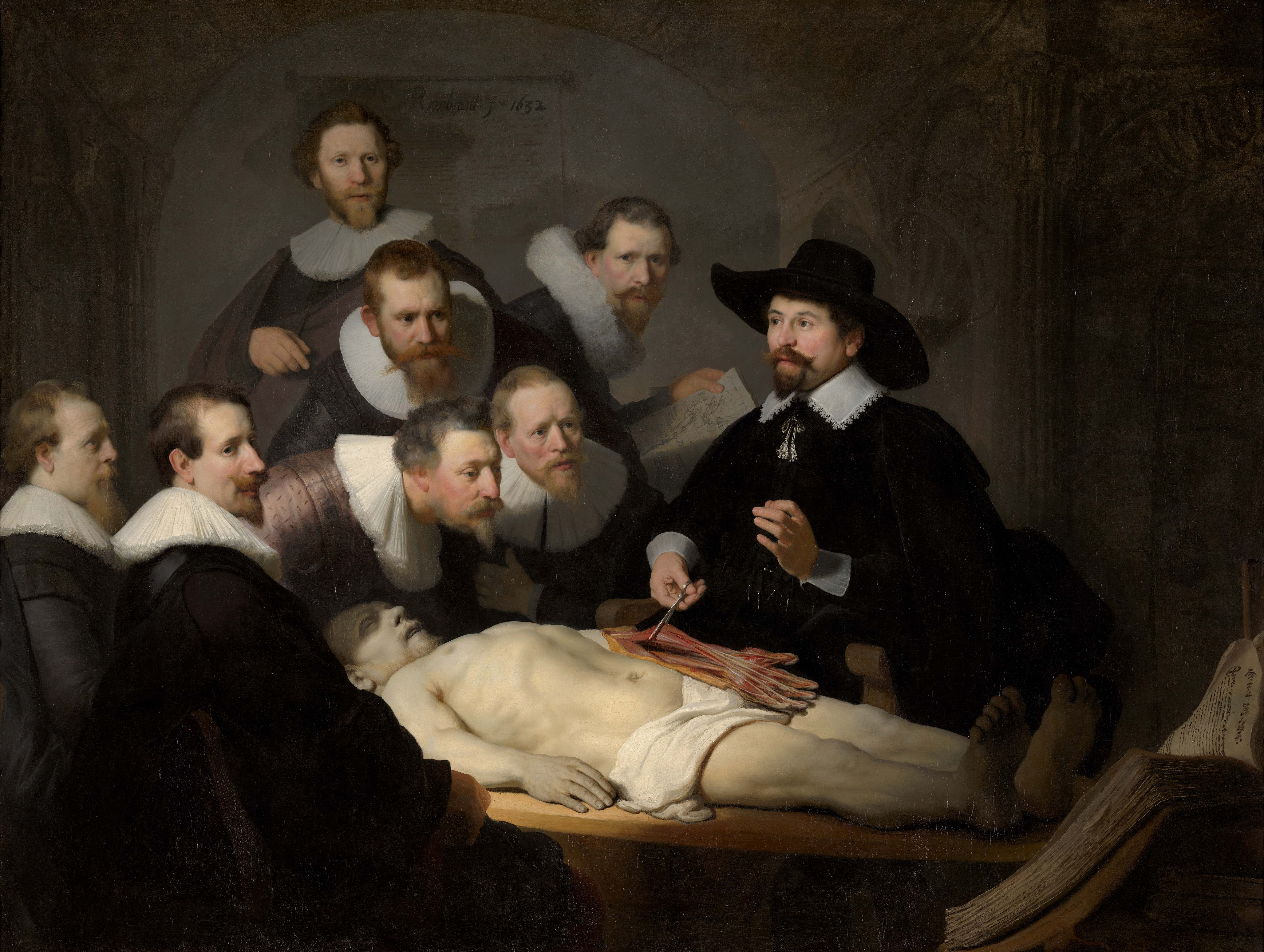
The Anatomy Lesson of Dr Tulp

Rembrandt, 1632
IdentityPre-1850
The Anatomy Lesson of Dr Tulp by Rembrandt
The Anatomy Lesson of Dr. Nicolaes Tulp, Rembrandt van Rijn, 1632, oil on canvas, 169.5 × 216.5 cm, Mauritshuis, The Hague

Overview

About This Work

The Anatomy Lesson of Dr. Nicolaes Tulp (1632) is a masterpiece of the Dutch Golden Age by Rembrandt van Rijn (1606–1669). Painted when the artist was only 25 years old and newly arrived in Amsterdam, this large oil on canvas (169.5 cm × 216.5 cm) is housed in the Mauritshuis in The Hague. The painting is a group portrait commissioned by the Amsterdam Guild of Surgeons to commemorate their annual public dissection. It depicts the renowned physician Dr. Nicolaes Tulp demonstrating the musculature of the arm to seven guild members. The corpse is that of Aris Kindt (Adriaan Adriaanszoon), a criminal executed for armed robbery earlier that same day (January 31, 1632). Rembrandt revolutionized the genre of the corporate group portrait with this work. Traditionally, such portraits were static rows of heads (comparable to a class photo). Rembrandt, however, transformed the commission into a dramatic narrative scene, unifying the figures through shared action and psychological intensity. It stands as a testament to the 17th-century fascination with science, the fragility of the human body, and the rising status of the medical profession.

Visual Analysis

Composition

Pyramidal Structure: The composition is fundamentally dynamic rather than static. The surgeons are not arranged in a straight line but form a loose pyramid or wedge shape on the left, their heads stacked at varying levels. This creates a sense of depth and informality, as if they are crowding around to see better. The Focal Point: The composition directs the viewer's eye immediately to the corpse, which is brightly lit and centrally placed. From there, the eye travels to Dr. Tulp's hands (the active agents of knowledge) and then to his face. Psychological Unity: Unlike earlier group portraits where sitters looked out at the viewer (seeking individual recognition), most of the surgeons here are focused on Tulp's demonstration or the textbook in the foreground. This creates a "psychological line" connecting the figures, unifying them in a shared intellectual pursuit. Dr. Tulp's Dominance: Tulp is visually distinguished from the group. He sits to the right, isolated against a darker background, and wears a hat (signifying his rank as praelector or professor). The other figures are bare-headed and clustered together, reinforcing Tulp's authority.

Colour & Light

Dramatic Lighting: Rembrandt employs his signature chiaroscuro (strong contrast between light and dark). A stark, theatrical light falls from the upper left, illuminating the corpse and the faces of the surgeons while leaving the background in shadow. This is not just naturalistic lighting; it is symbolic "light of reason" illuminating the darkness of ignorance (and death). The Corpse as Light Source: The cadaver is painted in pallid, greenish-grey tones but is so brightly lit that it almost seems to glow, reflecting light onto the faces of the observers. This creates a ghostly, morbid atmosphere that contrasts with the rosy, living flesh of the doctors. Restricted Palette: The colour scheme is restrained—dominated by blacks (the doctors' robes), whites (collars and the sheet), and earthy flesh tones. This restraint emphasizes the seriousness of the event and prevents distraction, focusing attention on the faces and the dissected arm.

Materials & Technique

The Flayed Arm: The focal point of the lesson is the dissected left forearm. Tulp uses forceps to lift the flexor digitorum muscles. His own left hand mimics the action of the muscles he is exposing, demonstrating how the tendons control the fingers. This visual parallel—between the dead mechanism and the living hand—is the painting's intellectual core. Anatomical Accuracy: Critics and doctors have debated the accuracy of the arm. The flexor muscles appear to originate from the wrong side of the elbow (the lateral rather than medial epicondyle). This suggests Rembrandt may have consulted an anatomical atlas (like Vesalius or Casserius) rather than relying solely on observation, or that he manipulated anatomy for aesthetic clarity. The "Hand of the Artist": By focusing on the hand, Rembrandt makes a subtle statement about his own profession. The hand is the tool of both the painter and the surgeon. By painting the "anatomy of the hand," Rembrandt is analyzing the very instrument of his own genius.

Historical Context

Context

The Dutch Golden Age and Science: 17th-century Holland was a hub of the Scientific Revolution. The Dutch Republic was Protestant, wealthy, and intellectually curious. Unlike in Catholic Europe, where dissection was restricted, in Protestant Amsterdam, public dissections were celebrated events (often held in winter to preserve the body) attended by students, burghers, and visiting dignitaries. They were viewed not as desecration but as a way to understand God's creation ("God's handiwork"). The Guild of Surgeons: The commission was a prestigious one. The Surgeons' Guild held one public anatomy lesson per year using the body of an executed criminal. Dr. Tulp was the praelector (reader/lecturer) of the guild and a powerful figure in Amsterdam politics (later becoming mayor). The men surrounding him paid to be included in the painting to assert their status and professional legitimacy. The Criminal (Aris Kindt): The corpse belonged to Adriaan Adriaanszoon (Aris Kindt), a glove-maker turned thief who was hanged for robbery and assault. In the 17th century, dissection was a "second punishment" for criminals—denying them a Christian burial. Vesalius and the Tradition: The painting pays homage to Andreas Vesalius, the father of modern anatomy. In classical portraits, anatomists were often shown with a skull. Here, Tulp is shown dissecting the arm, a direct reference to Vesalius, who famously wrote that the hand is the "instrument of instruments."

Key Themes

Knowledge vs. Mortality (Science and Death)

Triumph of Science: The painting celebrates the power of human reason to understand the world. Tulp is the embodiment of the new empirical science—looking, touching, and investigating rather than relying solely on ancient texts. Memento Mori: Despite the scientific triumph, the painting remains a stark memento mori (reminder of death). The grey, limp body of Aris Kindt contrasts sharply with the vibrant, living doctors. The shadow falling across the corpse's face (often called the umbra mortis or shadow of death) reminds the viewer that all this knowledge ultimately ends in the grave. The Body as Machine: The mechanistic view of the body (influenced by Descartes, who lived in Amsterdam at this time) is visible here. Tulp treats the arm like a system of pulleys and levers, de-sacralizing the human form into a biological machine. Group Identity and Status: This is a regents' portrait—a uniquely Dutch genre celebrating the civic groups (guilds, militias, charities) that ran the Republic. It asserts the dignity and social importance of the surgeon's profession, elevating them from mere craftsmen/barbers to learned men of science.

Exam Focus Points

Critical Perspectives

Innovation in Group Portraiture: The most crucial exam point is how Rembrandt broke the rules. Compare this to earlier examples (like Thomas de Keyser's Anatomy Lesson of Dr. Sebastiaen Egbertsz), which were static rows of heads. Rembrandt added narrative (a story is happening) and unity (everyone is reacting to the same event). The Gaze: Analyze the different directions of the gazes. - Tulp looks out/across (explaining). - Some doctors look at the arm. - The doctor at the top (Frans van Loenen) looks out at us, the viewer, inviting us into the circle. - The doctor in the foreground looks at the textbook (verifying Tulp's words against authority). The Hand: Discuss the symbolism of the hand. It is the "instrument of instruments." Tulp is demonstrating the muscles of the hand using his own hand, painted by Rembrandt's hand. It is a triple-layered commentary on manual skill (chirurgy = hand-work). Accuracy vs. Art: Rembrandt prioritized artistic effect over strict medical accuracy. He opened the arm first (usually the abdomen was opened first to remove rotting organs). He likely moved the muscle attachment points to make the visual explanation clearer. This shows Rembrandt as an artist interpreting reality, not just recording it.

On this page

OverviewVisual AnalysisHistorical ContextKey ThemesExam Focus Points