History o' Phoeart
  • Home

Nature

  • Overview
  • Landscape or Seascape in 2D
  • Animals in 2D or 3D
  • The Elements (Fire, Water, Wind or Earth) in 2D or 3D
  • The Relationship between Man/Woman and Nature in 2D or 3D

Identity

  • Overview
  • The Divine in 2D or 3D Works
  • Portraits in 2D Works
  • Portraits in 3D Works
  • Gender Identity in 2D or 3D Works

Renaissance

  • Overview
  • Religious Painting
  • Religious Sculpture
  • Mythological in 2D or 3D
  • Portraits in 2D or 3D

Baroque

  • Overview
  • Religious Painting
  • Religious Sculpture
  • Mythological Painting
  • Mythological Sculpture

About

A comprehensive study resource for Pearson Edexcel History of Art A-Level.

NatureIdentityRenaissanceBaroque

History o' Phoeart - A-Level Study Resource

Pearson Edexcel Specification • Use ⌘K to search

  1. Home
  2. Paper 1
  3. Identity
  4. Portraits in 2D Works
  5. The Ambassadors
Paper 1Identity
Identity
The Divine in 2D or 3D Works
Portraits in 2D Works
Pre-1850
The Ambassadors

The Ambassadors

Hans Holbein

The Anatomy Lesson of Dr Tulp

The Anatomy Lesson of Dr Tulp

Rembrandt

The Byam Family

The Byam Family

Thomas Gainsborough

Post-1850
Portraits in 3D Works
Gender Identity in 2D or 3D Works
Ethnic Identity in 2D or 3D Works
Identity in Architectural Works

6 scopes • 24 artworks

The Ambassadors

Hans Holbein, 1533
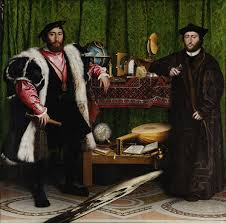
IdentityPre-1850
The Ambassadors by Hans Holbein
The Ambassadors, Hans Holbein the Younger, 1533, oil and tempera on oak panel, 207 x 209.5 cm, National Gallery, London

Overview

About This Work

The Ambassadors (1533) is one of the most sophisticated and enigmatic paintings in Western art history. Painted by Hans Holbein the Younger (1497/8–1543), the work measures 207 x 209.5 cm (oil and tempera on oak panel) and is housed in the National Gallery, London. It depicts two young French diplomats: Jean de Dinteville (left), the French ambassador to the English court, and his close friend Georges de Selve (right), Bishop-elect of Lavaur. The men stand on either side of an elaborately laden shelving unit displaying scientific instruments (astrolabes, globes, sundials), musical instruments (a broken-stringed lute, flutes), and religious texts (a hymnal). The painting celebrates the intellectual sophistication and cultural refinement of the Renaissance while simultaneously confronting the viewer with profound philosophical and theological questions about mortality, salvation, and faith. Most famously, the painting contains a distorted anamorphic skull—a skull rendered in exaggerated perspective that only becomes visible when the painting is viewed from a specific oblique angle—functioning as a memento mori (reminder of death). The work was painted during one of the most politically and religiously charged moments in European history: Henry VIII's break with Rome and his marriage to Anne Boleyn, which threatened the established order of Christendom.

Visual Analysis

Composition

The Frontal Double Portrait: The two ambassadors stand in the foreground, facing the viewer directly in a formal, heraldic pose. They are rendered life-size, creating an almost intimidating presence. The composition is symmetrical—the two figures balance each other, separated by the table of objects that serves as both physical and symbolic divider. The Table as Centre: The two-tiered wooden table is the compositional and symbolic fulcrum. It divides the composition horizontally while uniting it vertically. The men's arms rest upon or near the top shelf, suggesting that these objects are extensions of their intellectual authority. Upper and Lower Shelves—Heavens and Earth: Upper Shelf (Heavens): Celestial globe, polyhedral sundial, various astronomical instruments for measuring time and celestial movements. These represent the immutable, eternal realm. Lower Shelf (Earthly): Terrestrial globe (inverted, suggesting chaos or inversion), a broken-stringed lute (symbolizing discord), flutes, and an open hymnal (Martin Luther's hymnal, suggesting religious divisions). Spatial Recession and Perspective: Beyond the ambassadors and table, the background contains a patterned marble floor and a lush green damask curtain. The use of linear perspective creates spatial depth, yet the foreground objects are rendered with meticulous detail (hyper-realistic still life), while the background remains more schematic. This creates a slightly disorienting spatial relationship. The Anamorphic Skull: Stretching diagonally across the bottom centre of the composition is a large, distorted oval shape that appears as an incomprehensible white smear when viewed straight-on. When the viewer positions themselves to the right of the painting and looks at it from a low, oblique angle, this shape resolves into a perfect skull. This perspective distortion (anamorphosis) is a technical marvel demonstrating Renaissance mastery of optics and mathematics.

Colour & Light

Rich, Saturated Palette: The painting employs deep, jewel-like colours—burgundy reds, emerald greens, gold, blue—suggesting wealth and luxury. Holbein's technique renders fur, silk, and metal with such tactile accuracy that one can almost feel the textures. Holbein Carpet: The upper shelf displays an Anatolian carpet (often called a "Holbein carpet" because the artist depicted them frequently). These carpets were rare, expensive trade goods signifying the ambassadors' international sophistication. The Hidden Crucifix: Partially obscured behind the lush green curtain in the top left corner is a silver crucifix. This subtle religious imagery is deliberately marginalized and hidden, suggesting the fragility of religious authority in this moment of schism. Yet it is present, offering a promise of redemption that contrasts with the skull. Chiaroscuro: While not as dramatically employed as Rembrandt's work, Holbein uses subtle light and shadow to model the figures and create volume, giving them a convincing three-dimensionality.

Materials & Technique

Oil and Tempera on Panel: The work is painted in oil and tempera on oak panel, a medium that allowed Holbein to achieve extraordinary detail and luminosity. The smooth panel surface permitted the meticulous rendering of textures and reflections. Virtuosic Still Life: The scientific instruments are rendered with such precision that scholars have identified each object and its specific function. Holbein consulted with Nicolaus Kratzer, the royal astronomer at Henry VIII's court, to ensure accuracy. This precision serves both aesthetic (demonstrating skill) and symbolic (these are real instruments with real intellectual significance) purposes. Broken String on the Lute: The lute has a visibly broken string—a deliberate imperfection in an otherwise harmonious arrangement, symbolizing discord or the rupture of faith.

Historical Context

Context

1533: The Crisis of Christendom: The painting was executed in 1533, one of the most turbulent years in European history. In January 1533, Henry VIII secretly married Anne Boleyn, defying the Pope's refusal to annul his marriage to Catherine of Aragon. This set Henry on a collision course with Rome, which would culminate (one year later, in 1534) in his formal break with the Catholic Church and the establishment of the Church of England with himself as Supreme Head. Jean de Dinteville's Diplomatic Mission: Dinteville was sent by the French King Francis I to the English court to attempt to mediate the crisis and report on Henry's actions. His task was virtually impossible—he was caught between the Catholic world (represented by the Pope and his own king, who remained Catholic) and Henry's increasingly defiant stance. The painting was commissioned by Dinteville to hang in his château at Polisy in France, serving as a record of his ambassadorial importance. Religious Division in Europe: Beyond the English crisis, Europe itself was fractured. The Reformation (Martin Luther's challenge to Catholic authority) was gaining adherents. The presence of a Martin Luther hymnal on the lower shelf references this religious division. The inverted terrestrial globe may symbolize the world turned upside down by religious upheaval. Friendship Amid Crisis: While commissioned as a state portrait, the painting is also a portrait of genuine friendship. Dinteville's letter to his brother describes de Selve's visit to London as bringing him great comfort. In the context of diplomatic failure and religious turmoil, personal friendship and intellectual companionship become anchors of stability.

Key Themes

Identities (Diplomacy, Intellectual Authority, Mortality)

The Intellectual Elite: Both men display the markers of Renaissance learning—the books, instruments, and cultural artifacts surrounding them. They embody the humanist ideal—educated men conversant with classical learning, geometry, astronomy, music, and theology. The Active and Contemplative Lives: Dinteville (left), dressed in rich silks and holding a dagger, represents the active life (political power, military might). Selve (right), in clerical robes resting on a book, represents the contemplative life (scholarship, theology). Together, they represent a Renaissance ideal of the complete man—engaged with both action and contemplation. Futility and Failure: Yet beneath this confident display lies a suggestion of futility. Dinteville's diplomatic mission would ultimately fail—Henry would break with Rome, and Europe would be permanently divided. The inverted globe, the broken lute string, and especially the hidden skull suggest that despite these men's learning and wealth, forces beyond their control govern events. Death as the Great Equalizer: The skull violently reminds the viewer that despite their intelligence, position, and learning, these men—like all humans—are mortal. "Memento mori"—remember thou shalt die. The contrast between the worldly ambitions displayed in the painting and the leveling inevitability of death is the painting's ultimate message.

Exam Focus Points

Critical Perspectives

The Meaning of the Anamorphic Skull: Scholars debate why Holbein employed this extraordinary technical device. Possible interpretations include: Memento Mori: A straightforward reminder of mortality for the patrons. "Memento mori" as Dinteville's Motto: Historical records suggest this was Dinteville's personal motto—the skull's presence is thus a personal signature. Three-Tiered Universe: The painting represents three levels: heavens (upper shelf), earth (the men and lower shelf), and death (the skull). This creates a cosmological structure. Hidden Meaning: The skull's distortion forces active viewing—the viewer must move to comprehend it. This parallels the diplomatic mission: Henry's religious position is distorted and requires oblique viewing to understand. The Crucifix and the Skull: The painting presents two views of death and transcendence. The crucifix (barely visible) offers Christian redemption; the skull offers stark memento mori. The painting asks: Is death the end, or is there resurrection? The crucifix is hidden, suggesting the fragility of this hope in a world of political and religious turmoil. Technical Virtuosity and Meaning: Holbein's technical brilliance (the anamorphic projection, the meticulously rendered instruments, the precise spatial construction) is not mere display. Rather, the technique embodies the painting's themes: the Renaissance valorization of learning and mathematical precision is presented within a frame that reminds us of mortality and the limits of human knowledge. Political and Religious Context: The painting can be read as a sophisticated commentary on the political chaos of 1533. The inverted globe, the discord suggested by the broken lute, and the presence of a Luther hymnal all allude to the religious crisis without directly depicting it. Holbein achieves political commentary through symbolic allegory rather than narrative illustration. Comparison to Crivelli's Annunciation: Both Holbein and Crivelli use dense symbolic detail to convey meaning beyond the surface narrative. Both employ careful spatial construction to guide the viewer's gaze. Yet Crivelli celebrates Renaissance humanism through optimistic civic pride; Holbein introduces a philosophical memento mori that tempers Renaissance confidence with mortality awareness.

On this page

OverviewVisual AnalysisHistorical ContextKey ThemesExam Focus Points